
Applications in Plastic Surgery

Advanced Placental Allografts When Patients Are in Need
Providing Protective Barriers on Wounds and Thereby Supporting the Healing Process
There are many risk-factors to healing such as patient co-morbidities and complex defects.1 MIMEDX offers an array of advanced placental allografts that may be used in a variety of surgical applications to provide valuable benefits in patient care.
Product Advantages: AMNIOEFFECT®, AMNIOFIX®, and AMNIOCORD®
- Provides a protective barrier on wounds and thereby supports development of granulation tissue and the healing process
- Terminally sterilized for additional level of safety
- AMNIOFIX & AMNIOEFFECT: PURION® process preserves Extracellular Matrix (ECM) components, including 300+ regulatory proteins2,3
- AMNIOCORD: PURION process preserves ECM components, including 250+ regulatory proteins4
AXIOFILL®:
- A lyophilized, biocompatible, and human extracellular matrix derived from the placental disc
- For use in the replacement or supplementation of damaged or inadequate integumental tissue
- Versatile and easy to use: apply dry or hydrated as a paste
- Provides a scaffold that permits cellular ingrowth, an important step in the replacement or supplementation of damaged or inadequate integumental tissue5
Clinical Use Examples:
- Acute and chronic wounds
- Debridements
- Exposed bone and tendon
- Dehiscence
- Decubitus ulcers
- Flaps
- Bridge to STSG
- Limb salvage
Case Studies:
How Physicians Use Our Products
Case study 1
Acute Abdominal Wall Dehiscence With EPIFIX®6
Challenge
62-year-old obese male, BMI of 29, type II diabetes, with a history of hypertension, myocardial infarction with stent placements, multiple abdominal surgeries, and over forty years of cigarette smoking, underwent large ventral hernia repair. At one week post op, the patient developed ischemia at the incision line, which led to an incisional dehiscence.
Studies have shown a direct correlation between the number of comorbidities and clinical outcomes. A significant rise in complications, length of stay, and mortality rates is associated with the rise in number of patient comorbidities.7-9
Surgical Intervention
The patient was managed with serial debridement and wet-to-dry dressings for two months, then placed on negative pressure wound therapy (NPWT) for four weeks at home. After one month of NPWT, the wound had only decreased by 30%. NPWT was discontinued, and DHACM (Dehydrated Human Amnion/Chorion Membrane) was applied every other week, instead of weekly, due to the travel distance for the patient. The product provides a barrier that supports the healing cascade and protects the wound bed to aid in the development of granulation tissue in acute and chronic closures. The PURION process preserves ECM components.2,3
Follow-Up
Upon examination at his two month follow-up visit, the wound was fully closed and re-epithelialized. The patient returned for a routine one-year visit and has remained fully closed and asymptomatic.
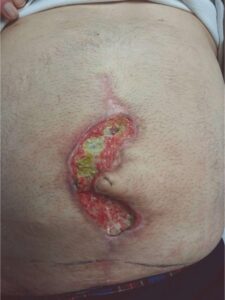 Following Debridement Following Debridement |
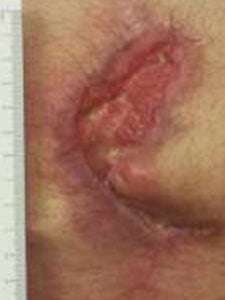 Four weeks of NPWT, only 30% size reduction, first DHACM 4 cm x 4 cm applied Four weeks of NPWT, only 30% size reduction, first DHACM 4 cm x 4 cm applied |
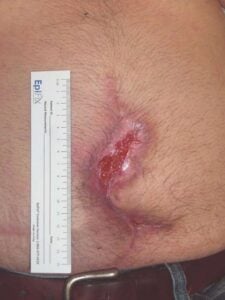 Week 2: Two 2 cm x 3 cm DHACM applied Week 2: Two 2 cm x 3 cm DHACM applied |
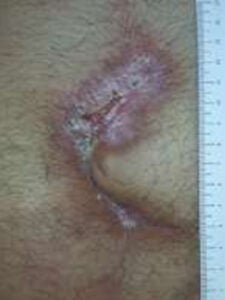 Week 4: One 2cm x 3 cm DHACM applied Week 4: One 2cm x 3 cm DHACM applied |
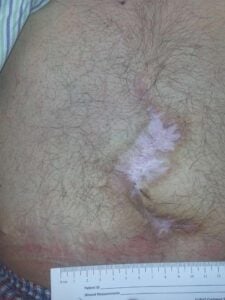 Week 8: Wound closed and stable Week 8: Wound closed and stable |
Case Study 2
Keloid Scar Revision With EPIFIX10
Clinical History
Patient presented with keloid scar after Caesarean section procedure.
Treatment
EPIFIX is a dehydrated human amnion/chorion membrane allograft. The product provides a protective barrier that supports the healing cascade and protects the wound bed to aid in the development of granulation tissue in acute and chronic closures. EPIFIX provides a biocompatible human ECM.1-3
Follow-Up
At year follow up, the one-third portion of the scar that was treated was greatly reduced in height and in color. Subsequent revision surgery managed the remaining two-thirds of the keloid scar with EPIFIX used to cover and protect the area.
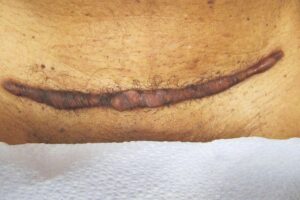 KELOID Scar Revision with DHACM KELOID Scar Revision with DHACM |
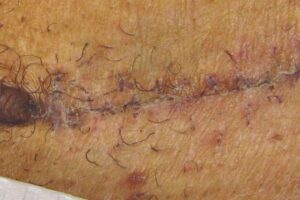 Post-scar revision using DHACM on 1/3 portion of original scar Post-scar revision using DHACM on 1/3 portion of original scar |
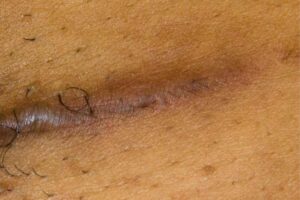 Scar one year post surgical treatment with DHACM overlay Scar one year post surgical treatment with DHACM overlay |
Surgical Product Portfolio: Advanced Placental Allografts
MIMEDX offers a portfolio of advanced placental allografts in the surgical setting.
| AMNIOFIX | AXIOFILL | AMNIOCORD | AMNIOEFFECT | |
| Complex Soft-Tissue Deficit | ✓ | ✓ | ✓ | ✓ |
| Large Area Coverage | ✓ | ✓ | ✓ | |
| Affix Product with Suture* | ✓ | ✓ | ||
| Product Thickness Desired | ✓ | ✓ | ||
| Exposed Bone, Tendon, or Hardware | ✓ | ✓ | ✓ | ✓ |
| Reposition Product after Hydration | ✓ | ✓ | ✓ | ✓ |
| Minimally Invasive Procedures | ✓ | ✓ | ||
| Fenestrated Configuration to Allow Transfer of Exudate | ✓ |
References